Houdini course at Indian VFX School · FLIP in Houdini, Karma and Mantra
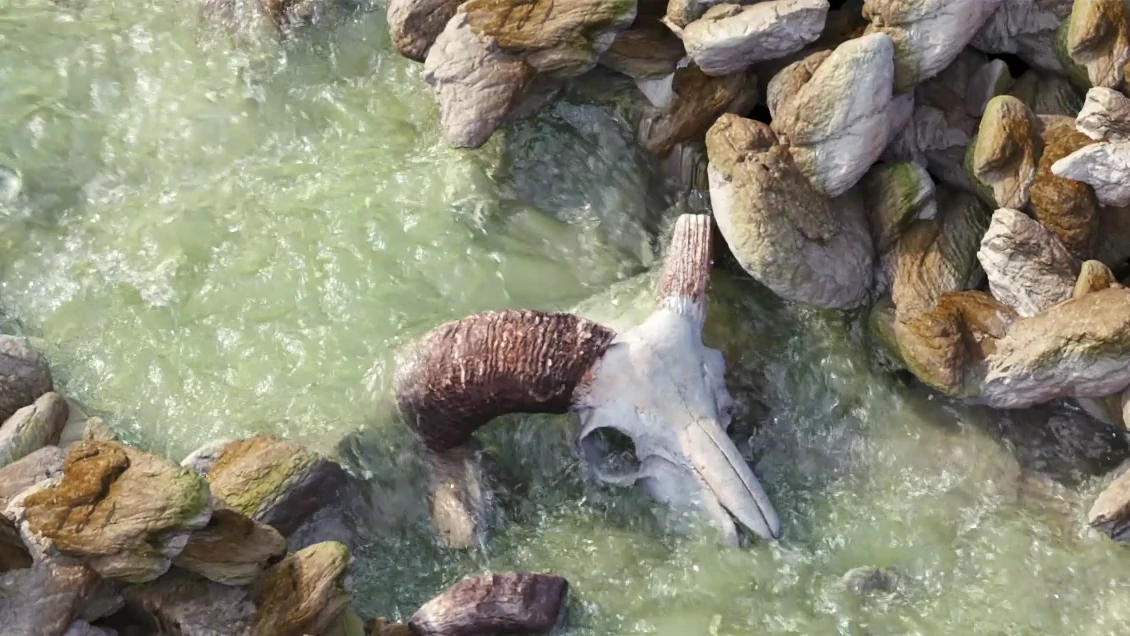
Everyone knows water, which is exactly why you notice straight away when it looks wrong in 3D. During my Houdini FX course at Indian VFX School I made two water simulations: a river flowing between rocks past a skull, and Crag walking through icy water with his hammer. Both were assignments from the course.
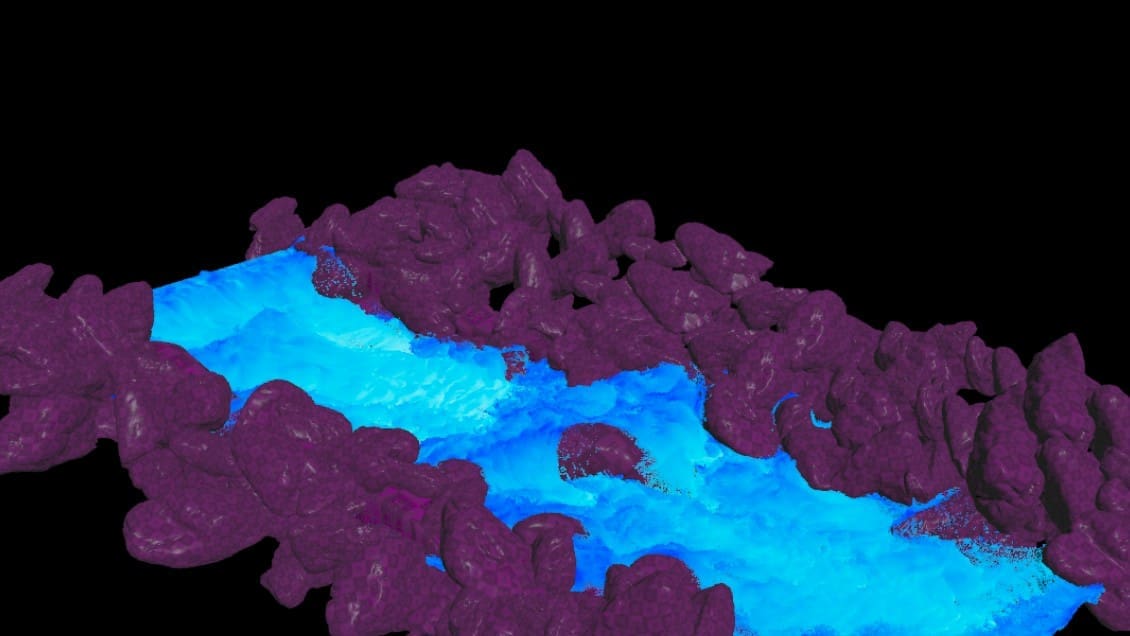
For both I used FLIP, the fluid simulation in Houdini. The water starts out as millions of tiny particles. Houdini calculates, frame by frame, how those particles flow, collide and splash. After that I turn them into a water surface, and that is what I render.
For the river, the water starts as a block of particles in the riverbed. I gave it a velocity in the direction of the flow and added a force, so it starts flowing straight away. The rocks and the skull are a collision object: the water cannot pass through them and flows around and over them. Each particle is one and a half centimetres across.

From all those particles I then built a closed surface, a mesh. I smoothed that surface a little, so it reads as real water. I rendered the river in Karma, the renderer in Houdini, with an HDRI as the light.
Crag is the test character that comes with Houdini, a rock monster with a sledgehammer. In this assignment he walks through a pool of ice water and strikes the water with his hammer. The pool is a flat tank: a tank of water with waves along the edges. The particles are even smaller here, 6 millimetres, for more detail around his legs and the hammer. Crag, the icebergs and the snowy rocks are collision objects.

The foam, the spray and the bubbles are a separate simulation called whitewater. Houdini looks for the places where the water spins, speeds up or curls over, and creates white particles there. I also made a difference in the colour of the water: calm water is ice blue, churning water turns white. I rendered this shot in Mantra.
During the course I practised more with water. A speedboat pulls a foamy wake through the water, and a letter E glides through it at velocities I set up myself.
Simulations like these are heavy to calculate. That is why I saved everything in steps: first the particles, then the water surface and then the whitewater. That way I could adjust the light and the render without running the simulation again each time.
You can read more about what I make in Houdini under 3D animation and Houdini VFX.
Next project: Set Fire to the Rain →
E-Line Vision
Bringing vision to light.
I use cookies for statistics, the chat, YouTube videos and the spam protection of the contact form. This only happens if you give your consent. You can always change your choice via ‘Cookie settings’ at the bottom of the page.